
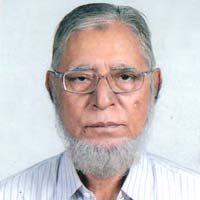
Professor M. Enayet Ullah
Editos in-chief
North East Medical Journal
It is common knowledge that the fundamentals of the health policy of a government is to provide stratified health care to as many citizens and as best as possible within its means without unduly stretching the exchequer. In this the service provided has to be safe, easily available and cost effective ensured by specific guidelines regarding investigations, interventions, managements and so on. All these are best achieved through establishing Medical Colleges, Paramedical institutions and Nursing colleges at strategically located regions of the country as per Medical Education and Health policy of the government to produce the intended skilled man power of standard quality and better.
Focusing on the under graduate medical education, the course and curriculum are produced under the aegis of the BMDC keeping in view the national needs and objectives in the above regards. In all these the role of the University is more or less that of a facilitator in the attainment of the educational objectives to produce safe and competent medical graduates.
Without doubt there is need for producing sufficient number of medical graduates and postgraduates in order to provide increasingly efficient and expanding primary, secondary and tertiary health care to the populace. But as is aptly said, quality and quantity do not always go hand in hand thereby meaning that as the quantity of production of a given commercial product goes up its quality goes down almost invariably unless a strict quality control system is put in place and enforced. It is exactly to this end that the FIMC (further improvement of medical colleges) project devised the QAS (quality assurance scheme) pertaining to the quality of medical education in the country which is laudable and practicable given the will. Unfortunately, however, problems arise while trying to implement all these in letter and spirit for the simple reason that there are just not enough trained, motivated and experienced manpower at various teaching and training levels for the under graduates to translate the vision of QAS fully into practice. Perennial vacancies at various vital teaching and training levels beginning with the post of assistant registrar, lecturers, registrars, right up to the post of assistant professor and above at various clinical and other levels are rampant giving rise to not only grave disproportion between teacher-student ratio (ideal 1:10) but also to a serious crisis in the steady production of varied and standardized teaching and examination items (varied X-Rays/clinical photographs/biochemical & hormonal reports/case scenerios etc) in order to meet the need of the almost continuous series of various terms and university examinations taking placed round the year under the new curriculum. The academic predicament thus prevailing in both public and private medical colleges in varying degrees is likely to get worse if the pace of virtual mushrooming of medical colleges on various considerations continues unabated.